
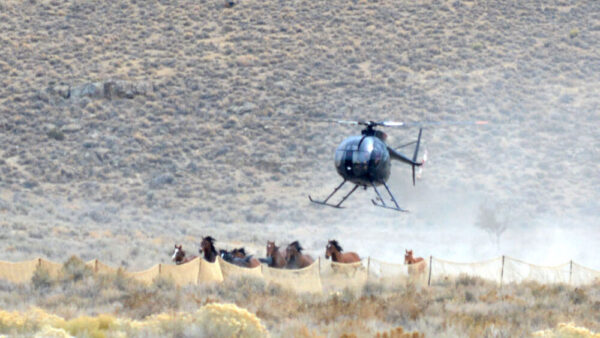
A helicopter drives Triple B wild horses into a trap site on Nov. 5, 2025. BLM photo.
The Bureau of Land Management is preparing to capture and remove 2,700 wild horses in two helicopter roundups in Nevada.
The BLM has no plans to treat and release horses with proven, safe and humane fertility control, meaning that the agency will soon return to the same areas to remove more horses.
Starting Friday, the BLM will remove 2,000 “excess” wild horses — the largest roundup in the agency’s history — from the 1.2-million-acre Callaghan Complex of Herd Management Areas (HMAs) in Lander County, Nev.
The agency’s stated purpose for the roundup: lower the population closer to an agency-set “Appropriate Management Level” of 323–552 wild horses across the complex and improve traffic safety. The BLM estimated that there were 4,489 horses in the complex in February 2025.
By comparison, the agency allows up to 61,581 Animal Unit Months of seasonal private grazing on the complex for privately owned cattle and sheep — the annual equivalent of 5,132 cow-calf pairs.
Actual livestock use over 10 years has been less than half that, according to planning documents. The agency allows tens of thousands more livestock in nearby areas not managed for wild horses.
A 700-horse roundup is set to start July 20 in and around the Lahontan Herd Management Area in Lyon and Churchill Counties. It measures 9,687 acres but the roundup will cover about 239,000 acres of the surrounding area.
The agency’s stated reasons for the roundup include reducing what it says is range degradation caused by horses and a lack of water.
The Lahontan HMA has an Appropriate Management Level of seven to 10 wild horses. The agency estimates there are 809 in and around the HMA. It allows up to the annual equivalent of 10 cow-calf pairs to graze there.
Captured wild horses from the roundups will be shipped to the Palomino Valley (Reno, Nev.) or Indian Lakes (Fallon, Nev.) Off-Range Corrals to be prepared for sale or adoption.
They will join more than 58,000 captured wild horses and burros already being warehoused in off-range government facilities — a direct result of the BLM’s failed attempts to try to manage wild horse populations almost entirely by capture and removal.