
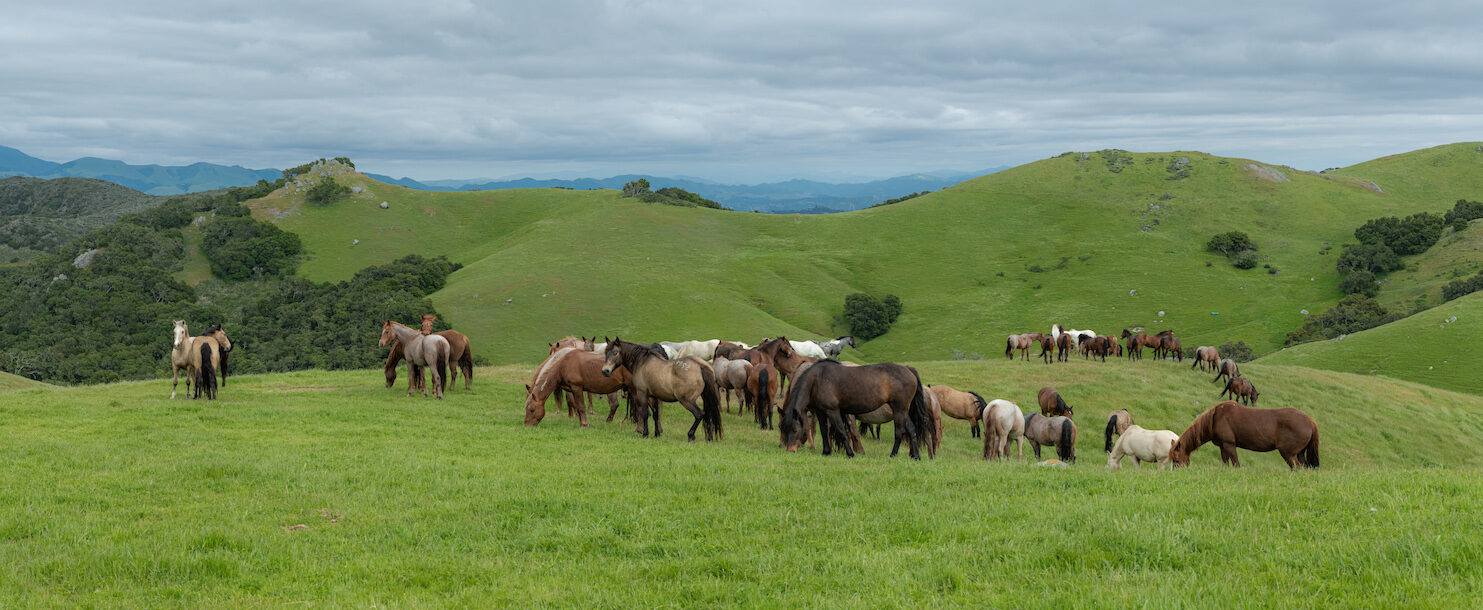
Wild horses at RTF’s San Luis Obispo, Calif., satellite sanctuary. Photo by Cathy Wallace.
Read the full article and see photos from our San Luis Obispo, Calif., satellite sanctuary.
Take action for wild horses and burros. Visit our sanctuary. Donate to support our work.
Federal agencies manage wild horses on public land across the West, including in SLO County
By Camillia Lanham
New Times (San Luis Obispo, Calif.)
Feb. 6, 2026
For four years, Colette Kaluza’s driven across California, Nevada, Utah, Wyoming, and other states, traversing paved highways and barreling down dirt roads, picking her way across rugged terrain to find hard-to-reach places with the help of her trusty GPS app.
After damaging a vehicle along the way, she purchased a Jeep Grand Cherokee with a Trailhawk package.
“I bought that car for roundups,” she said. “This car will go anywhere.”
That’s how dedicated she is to the wild horse cause. Kaluza, who splits her time between Pismo Beach and Nevada, records what happens when federal agencies conduct gathers to reduce the size of horse herds on public land, so she can share it with the public.
“You can’t imagine how bad it is,” Kaluza said. “It’s the fear, it’s the sound, it’s the duration, it’s all parts of the roundup operation. … They push the horses with a helicopter for, who knows, miles.”
An estimated 80,000 wild horses and burros gallop and graze through 29 million acres of Bureau of Land Management (BLM) and U.S. Forest Service Land in 10 states across the American West. Those animals are federally protected thanks to The Wild Free-Roaming Horses and Burros Act of 1971.
It declared that “wild free-roaming horses and burros are living symbols of the historic and pioneer spirit of the West … and that these horses and burros are fast disappearing from the American scene.” The act aimed to protect wild equines from “capture, branding, harassment, or death” and specified that they are to be protected and managed as “components of the public lands.”
…
The government wants to reduce herd numbers to “appropriate management levels,” which the BLM describes as “the best way to ensure healthy horses and burros on healthy rangelands.”
“If left unmanaged, herds can double in size in just four to five years and quickly outgrow the ability of the land to support them,” the BLM states on its Herd Management website.
A wild horse herd in SLO County has a different issue. The Black Mountain Wild Horse Territory in Los Padres National Forest has a herd so small that it’s in danger of becoming extinct, Kaluza said.
The herd management plan, which hasn’t been updated since the 1980s, states that the herd’s appropriate management level is 20 horses. As far as Kaluza can tell, there are only eight horses alive and well in the 13,000-acre territory.
Los Padres counts the number of horses at 10.
…
Most of the herd management areas or wild horse territories are much larger than Black Mountain’s 13,000 acres. Devil’s Garden Plateau Wild Horse Territory, for instance, is about 258,000 acres of land in northeastern California. It’s jointly managed by Modoc National Forest (248,000) and the BLM’s Applegate Field Office (7,600 acres) and includes some private and tribal lands as well.
…
As Neda DeMayo put the side-by-side in park, she pointed to the right, where the Devil’s Garden dozen was standing together, their thick winter coats catching the sun.
“Those are big-boned,” DeMayo said. “They like to range.”
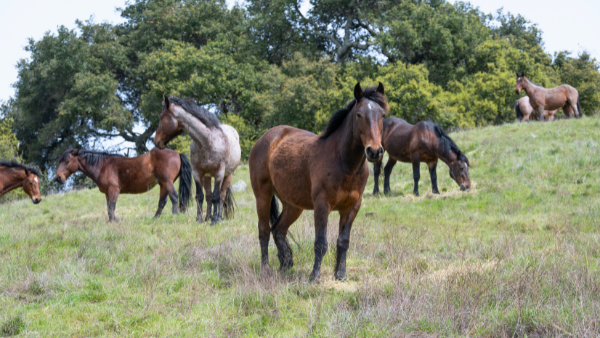
Devil’s Garden wild horses at RTF’s San Luis Obispo, Calif., satellite sanctuary. Photo: Meg Frederick.
Devil’s Garden conducts roundups all the time, she said. These horses were adopted out for $1 a piece, although she isn’t certain of the exact year.
To the left, on the ridgeline, two family bands from the BLM’s Red Desert Horse Complex in Wyoming looked down at the vehicle and its occupants.
“They’re so bonded,” she said. “They’re always together.”
Closer, the Cold Creek band from BLM’s Wheeler Pass Herd Management Area in Nevada meandered toward horses from Oregon’s Hart Mountain National Antelope Refuge—which is managed by the U.S. Fish and Wildlife Service.
In 1998, Fish and Wildlife removed all of the wild horses from the refuge, and DeMayo took 25 of them.
“That’s when I started Return to Freedom,” the president and founder said. “Some of these horses were born at the sanctuary.”
DeMayo’s nonprofit began on her Jalama Road ranch in Lompoc. It expanded in 2015 to include 2,000 acres of SLO Springs Ranch off Prefumo Canyon, and it also has horses on land in Texas. Of Return to Freedom’s almost 500 horses, 68 of them graze in SLO hills alongside 15 cows and 23 burros.
“Most of the horses that are here were together in the wild,” she said. Return to Freedom aims to let “them live as they’re designed to live.”
Return to Freedom Wild Horse Conservation aims to preserve the freedom, diversity, and habitat of wild horses and burros by providing sanctuary, advocating on their behalf, educating the public about them, and conserving unique bloodlines.
Watching a helicopter roundup on television in the 1990s pushed DeMayo to do something about the issue. But she didn’t want a place where horses were in pens. DeMayo wanted to enable the animals to stay wild and maintain their tight-knit social groups.
As she got more involved with the issue, she started to understand the politics around public resources.
“It’s a battle, and these guys are on the front line,” she said. “We would like to see horses managed on the range … and roundups to end.”
Cory Golden, Return to Freedom’s advocacy and outreach manager, said that DeMayo didn’t set out to participate in the issue’s politics.
“Quickly, though, she discovered that sanctuary alone couldn’t save the wild horses on our public lands, because the number of horses being removed exceeds the capacity that sanctuaries can offer,” Golden said. “To help keep wild horses on the range, she had to get involved with policy.”
[Return to Freedom lobbies elected officials and other meets with advocacy organizations and other public lands stakeholders.]“We view proven, safe, and humane fertility control as a key tool for ending inhumane government herd management by capture and removal,” he said. “From the start, though, we have also been active in the effort to end horse slaughter, which remains a threat to domestic and wild American equines alike.”
After a roundup, most of the captured animals end up in government holding—corrals or leased pastures—and they’re offered up for adoption or for sale, Golden said. Not all of them get adopted. While the BLM and Forest Service aren’t legally allowed to sell to kill buyers, the agencies don’t generally track what happens to horses or burros once their titles pass on to a new owner.
“They can fall through the cracks,” he said. “They can end up at auction.”
Difficulty with training a wild horse can result in its sale, as can rising costs, a divorce, or some other major change in an owner’s life. A horse could pass through several hands before ending up at an auction, where equines get sold and sometimes shipped out of the country, potentially ending up at a slaughter factory, Golden said.
“Our goal is to get a piece of legislation passed that would place a ban on horse slaughter and also ban the export of horses [for slaughter],” he said. “There’s a lot of bipartisan support for it.”
Polling shows that 80 percent of Americans oppose horse slaughter, he added.
Conversations about how to manage horses and burros on public lands are a bit more complex. The legislation passed in 1971, for instance, didn’t come with clear management guidelines. It does require agencies to set and maintain population targets, he said, which the agencies have “tried and failed” to manage through “capture and removal.”
That 1971 act also isn’t the only law governing how wild equines get managed. Golden points to The Federal Land Policy and Management Act of 1976, which requires public lands to be managed for multiple uses. This includes livestock grazing, recreation, mining, protected species, and a litany of other things that are competing for resources and attention within federal agencies.
“All of those uses have to be balanced out by those agencies, which is obviously a difficult task,” Golden said. “They are admittedly in a difficult position, but the answer to this—we believe—is fertility control.”
The agencies can’t manage wild herds and continue to ignore reproduction, Golden said, as a herd’s population can return to pre-roundup numbers within a few years.
“Population modeling has shown that immediately implementing fertility control alongside any removal that the agencies are already conducting is the only realistic way to stabilize herd growth,” he said. “If they don’t use fertility control, they’re only perpetuating a costly cycle of capture and removal that will not work.”
Return to Freedom uses the fertility control it advocates for on its own horses and burros. DeMayo said it’s between 91 and 98 percent effective. Since 1999, they’ve used a non-hormonal, reversible birth control vaccine.
If federal agencies used it more consistently, Return to Freedom estimates it would save more than 40 percent on herd management costs.
“One stallion can impregnate like 100 mares, so it’s just slowing it down,” DeMayo said. “It’s a tool you can utilize.”
The tool is just one that Return to Freedom uses to demonstrate the herd management techniques it advocates for. Another is something DeMayo calls holistic regenerative grazing—using temporary fencing and enticement like hay or alfalfa, Ranch Manager Kas Bryan ensures that SLO Springs Ranch doesn’t get overgrazed or too impacted by the horses and burros.
It’s a relatively new technique for Return to Freedom, one that’s been successful and will be used on the Lompoc ranch in the near future.
DeMayo calls her work “a heart condition.”
She was surrounded by horses on the move and knew each of them by name. They’re her people. Sophia has the black nose. She’s from Devil’s Garden. Shilo’s black and beige. The palomino close by is named Winter. Lizard, a bay, has always been a bully, she said with a laugh.
She and Bryan noticed one horse a few feet up the hill that was thinner than she should be. DeMayo asked Bryan to check her teeth.
“You fall in love with them,” she said. “I feel like when I’m with them, I’m present here.”