
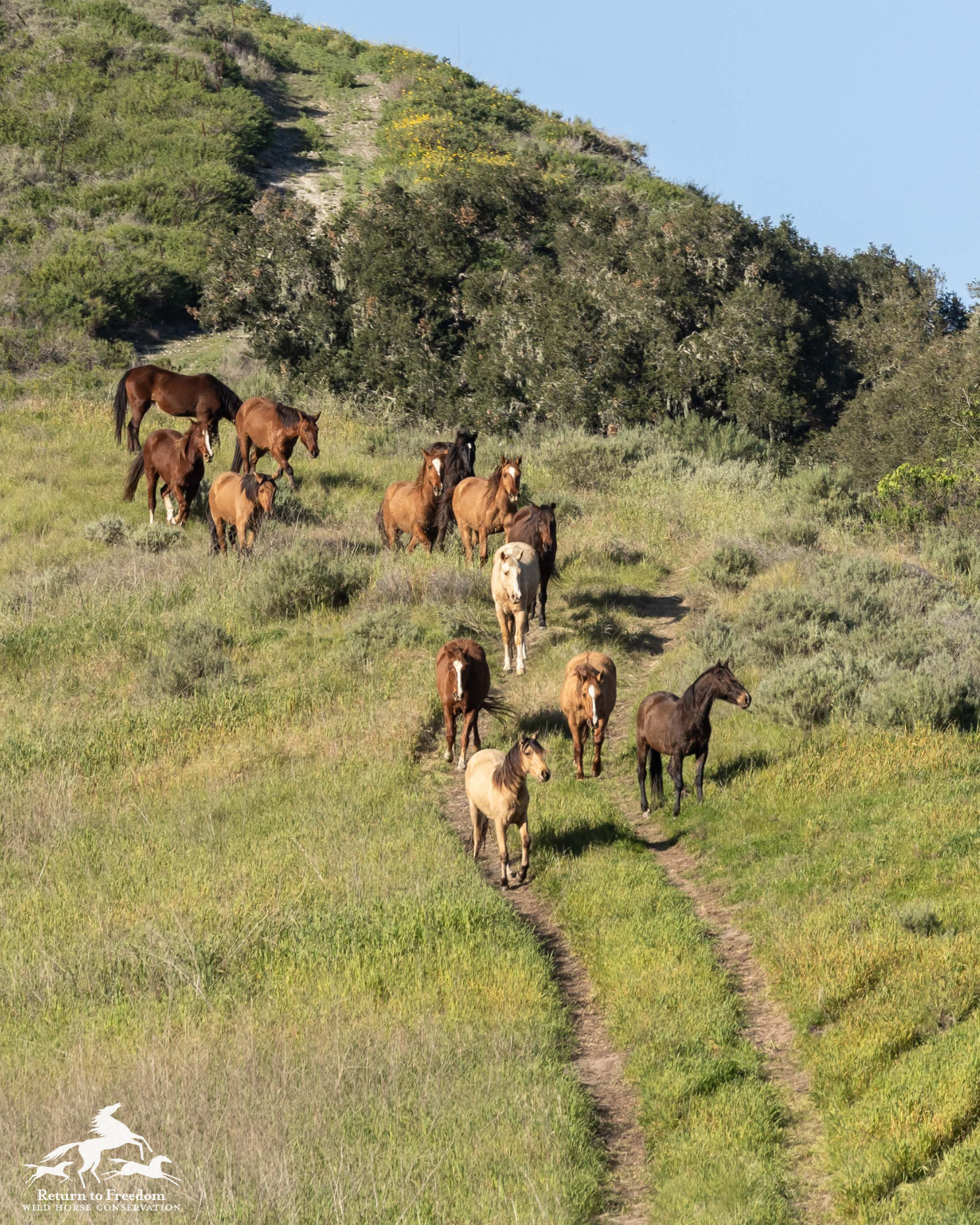
We’re excited to share an update about our Alpine herd and its beautiful new home at Babcock Winery & Vineyard near Lompoc, Calif.!
The project:
In all, 40 wild horses will make their home on 95 acres at Babcock Vineyard. They remain under RTF’s ownership and management. Our project manager, Aaron Thayne, began mapping the project last fall, and about two dozen volunteers helped clear dozens of acres of old vineyard trellising and driplines.
Babcock Winery & Vineyard:
Founded in 1978 and located in Sta. Rita Hills near Lompoc, Babcock Winery produces a wide variety of award-winning wines. The operation is owned by Bryan Babcock, one of the top winemakers in Santa Barbara County, and his wife, Lisa Boisset-Babcock.
We’re deeply grateful to them for partnering with Return to Freedom and recognizing the value of holistic land management, and to Duke Richardson and Annalee Knutson’s philanthropy.
Regenerative grazing at Babcock:
Managed holistically, horses benefit and heal the land. We are creating “trails” from grazing units to a central watering station, mimicking how horses create tracks and travel through the landscape. This keeps the horses moving, keeping their hooves trimmed and healthy, while minimizing negative impacts on the landscape — something for which wild horses are too often blamed.
Our Alpine herd:
The U.S. Forest Service removed the horses from the Apache-Sitgreaves National Forest’s Alpine Ranger District in Arizona. A confluence of events landed them at a Texas auction frequented by kill buyers. We worked with fellow nonprofits All Seated in a Barn and Salt River Wild Horse Management Group to rescue what became a total of 55 horses after some of the mares gave birth.
Tracking our progress:
USDA scientists will test and monitor microbial and fungal communities after the horses have contributed their part to feeding and healing the soil. This could prove advantageous for farmers whose crops suffer from bacterial diseases that may be exacerbated by unhealthy or dead soils.