
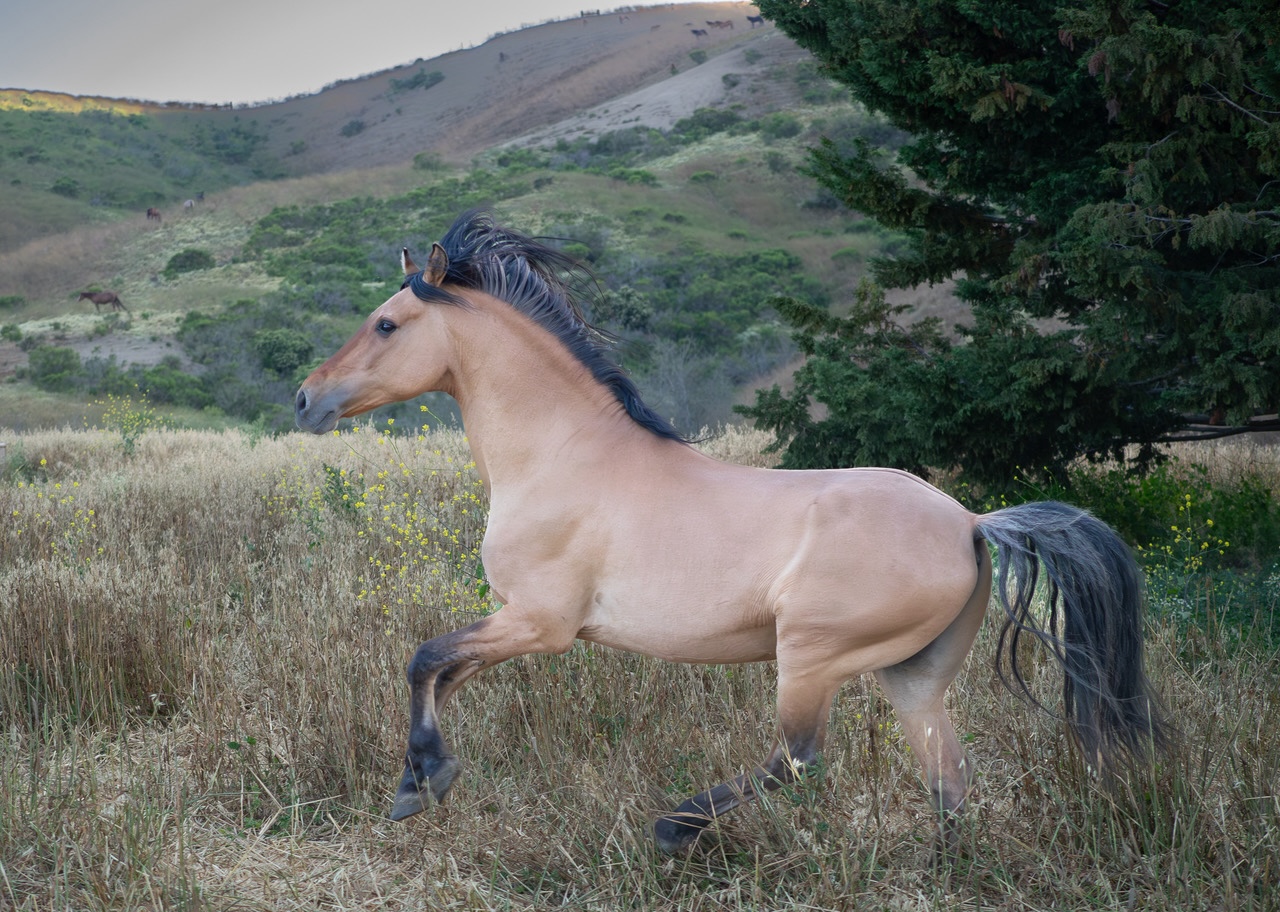
Spirit photographed by Marla Dell
Learn more about visiting the sanctuary
Support our work
As published by The Montecito Journal
Return to Freedom’s Founder Neda DeMayo has had horse sense since her earliest memories.
“Horse was my first word,” DeMayo says. “I have been passionate about horses since I was born, or at least I can’t remember a time when I wasn’t.”
DeMayo first began riding when she was five years old, but it was another incident at the same time that informed what has become her passion for most of the last three decades.
“I saw wild horses being captured and chased on television back in the early ‘60s,” she recalled. “Fast forward to the ‘90s when the Associated Press was exposing what was happening with America’s wild horses and burros under the Bureau of Land Management, and I was incensed. That’s when I knew it was time to take action.”
DeMayo’s idea was to start a wild horse sanctuary that would not only serve as wide open space for the threatened free-ranging equines, but also serve as a natural preserve and a place for education and advocacy to help more than the horses she could rescue on site.
The result was Return to Freedom, a national 501(c)3 wild horse conservation organization whose mission statement says it all: “RTF is dedicated to preserving the freedom, diversity and habitat of America’s wild horses and burros through sanctuary, education, advocacy and conservation, while enriching the human spirit through direct experience with the natural world.”
RTF opened its American Wild Horse Sanctuary back in 1998 with a 300-acre ranch in Lompoc, and now runs three different locations in the Central Coast.
While herds of wild mustangs and other horses still roam free on public lands, that iconic symbol of the American West is under increasing threat as the Bureau of Land Management’s multiple-use management policy calls for sharing the dwindling open public spaces with private livestock grazing and oil and natural gas extraction. To thin the herds, BLM still employs high-tech roundups that result in removal and separation from their families, which causes the horses as much anxiety as policies toward undocumented immigrants at the Mexican border. Adding to their pain, many of the horses end up in overcrowded corrals for years, or worse yet, sent off to slaughterhouses.
Return to Freedom has a different idea.
“We relocate intact family bands, which lets people who visit understand what we’re losing out there, and that horses are sentient beings who live in strongly bonded bands,” DeMayo explained. “They suffer when they are separated, just like we would. And too many end up spending their lives in overcrowded pipe corrals that are supposed to be temporary holding facilities, which is now costing the taxpayer $100 million a year.”
As a solution-focused organization, RTF advocates for minimally invasive management of wild horses and burros, and medical solutions to reduce population growth.
Meanwhile, the nonprofit maintains a total of 2,500 acres; space that not only provides safe haven for more than 450 wild horses and burros who have been removed from public lands, but also provides opportunities for education to expand awareness of the situation and foster understanding of these magnificent animals.
The situation has become more dire in recent times, with Washington’s cutback on domestic programs, with the president’s recently proposed budget which not only slashes funds by more than 33%, but excises prohibitions against the government killing healthy wild horses and burros or selling them for slaughter.
But RTF works with an attitude of cooperation rather than confrontation.
“We’re one of the few wild horse advocacy organizations that has a respectful communication so that we can find common ground solutions to protect the freedom of America’s wild horses, both on the range and off,” DeMayo said.
RFT has also forged partnerships with local organizations, including most recently Babcock Winery, where a recently rescued herd of 55 horses will be involved in regenerative holistic grazing.
“We’re very excited about expanding on what we’re already doing in Lompoc and San Luis Obispo,” DeMayo said.
“We love taking people around and sharing the history of the various horses here at the Lompoc facility because they represent a lineage that goes back to the original Spanish horses that first arrived in America,” DeMayo said.
Perhaps the perfect introduction to the nonprofit is happening next month with the annual opening day celebration that marks the start of Return to Freedom’s 2026 program season and the 31st birthday of the sanctuary’s most famous resident: Spirit, a Kiger mustang stallion who was the muse for DreamWorks Animation’s 2002 film “Spirit: Stallion of the Cimarron.” This year’s event is even more special as it comes within the Chinese calendar’s Year of the Horse.
Activities include a Chumash blessing, followed by traditional Navajo dance and song with Jones Benally and Clayson Benally (featured in the new IMAX movie Horsepower), Spanish classical guitar with Josiah Frias, wine pourings from premier local vineyards Flying Goat Cellars, Babcock Winery, and Beckmen, and eclectic locavore food catered by Full of Life Foods. Guests will also have the opportunity to meet some of the animators who worked on Spirit: Stallion of the Cimarron as well as the actual animal, who was just seven at the time of the movie’s production. Raffles, vendor booths, auction items, horsemanship demonstrations, mini-sanctuary tours, gift bags, and a personalized mustang photography photo round out the May 9 afternoon celebration.
“Spirit will be here as well as a wonderful display of other horses that people can meet on site,” DeMayo said. “It’s a real casual event, just an afternoon at the ranch. But the funds we raise are vital.”