
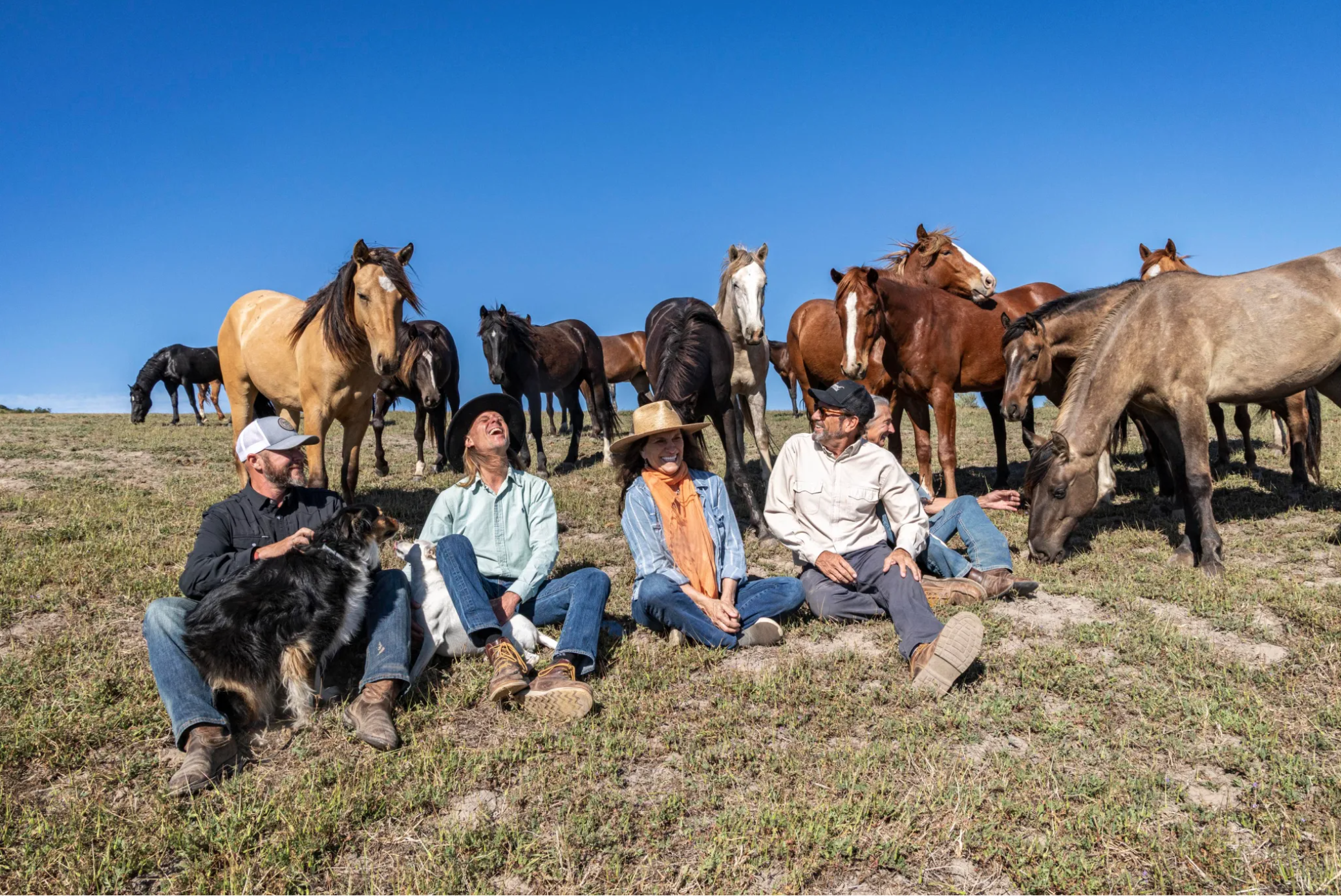
After years of fighting vine disease, Bryan Babcock is turning his property into a regenerative lab, including the introduction of horses the aerate and fertilizer the earth. From left, Aaron Thayne, Bryan Babcock, Neda DeMayo, Duke Richardson, and Annalee Knutson with wild horses rescued by Return to Freedom at Babcock Vineyard. Credit: Macduff Everton, Santa Barbara Independent
Jumping into Regenerative Wine: Santa Barbara County Vintners Join Global Effort to Fix Farming
As published by Santa Barbara Independent
It’s an unseasonably sunny and warm February morning in the Santa Ynez Valley, where about 50 winemakers and farmers are standing in a circle under the shade of a giant peppercorn tree. They’ve gathered at the deLanda Vineyard on the edge of Los Olivos to learn more about the One Block Challenge, a global effort to encourage vintners to adopt regenerative agriculture techniques in their vineyards.
“Everybody is listening,” explains vineyard consultant Jordan Lonborg about how much the world is excited about the hope of regenerative ag, which seeks to farm more in tune with rather than against nature, specifically by focusing on the health of the soil and surrounding ecosystem. “Everybody is paying attention.”
…
Sheep, chickens, ducks, geese, goats, cattle, and even alpaca are animals that have been used in vineyards across the world to munch the weeds, eat bad bugs, and aerate and fertilize the soil with their steps and shits. Could horses do the same thing?
That’s what veteran vintner Bryan Babcock and the team from Return to Freedom Wild Horse Conservation (RTF) are pondering on his Sta. Rita Hills property, where his family started growing vines in 1978. There are now 40 wild horses — saved from their pending slaughter by RTF after they were captured on federal land in Arizona — frolicking in the meadows above his winery on the northside of Highway 246.
Rather than grazing amid the vines, the horses pasture on parts of the property where vines have already been ripped out. The estate was ravaged by pests over the decades, long ago by phylloxera and more recently by Pierce’s disease, a sharpshooter-spread bacterial scourge that remains a significant worry for the region.
“The reality going forward is that more and more people are giving up,” said Babcock, pointing to other struggling examples on the slopes nearby. His remaining vineyard acreage is just a couple acres, down from a peak of about 80. He once made 25,000 cases of wine a year, and that’s dropped to just 5,000, mostly from purchased fruit.
The hope is that the horses’ heavy hoof prints create effective water-catching pockets in the earth and that their steady fertilizing enhances the microbiology of the soil. That’s what is happening at a once-desolate property near San Luis Obispo’s Perfumo Canyon, where RTF-introduced wild horses rejuvenated the landscape, according to RTF founder Neda DeMayo.
“The ecosystem and biodiversity exploded,” said DeMayo. “The insects are so loud.” Her longtime ranch manager Aaron Thayne agreed, explaining, “Springs that used to go out during June and July are now year-round.”
The Babcock connection was fostered and in part funded by Duke Richardson, who has long ties to the region, and equestrian Annalee Knutson, who works with RTF. Thayne started mapping out the management plan across 95 acres last fall, and the horses were brought to the property earlier this year. Based on his years of landscape management experience, Thayne doesn’t see why horses wouldn’t be as effective as any other hoofed animal in restoring this landscape.
“It’s not about the number of animals or which species,” he explained. “It’s the amount of time that they spend in one place.” He’s installing fencing across the property to move the horses around throughout the year — as he expected, they aren’t showing any interest in actually eating the vines that they have open access to — and there are periods when they will be much closer to the tasting room itself.
That may be an auxiliary benefit. “Many customers just don’t want a great wine,” said Babcock. “They want an experience.”
He believes there is a chance that, with the horses creating healthier soils, his property’s natural immune system could improve enough over time that it would overcome the pressures of Pierce’s and other vine diseases in the future. Maybe he’d even replant if all went well and the soils were laced with strong mycorrhizal networks.
“We might have a vineyard that we don’t have to irrigate, where the soil is healthy and we are more resilient to disease,” he said. “The potential is mind-boggling.”
After years of developing concepts and techniques of his own under such names as “integrated nature” and “agresthetics” (which casts farming as a work of art), Babcock’s vision for his estate’s potential role in a regenerative future doesn’t stop at horses. “We are trying to turn our entire property into a regenerative farming laboratory,” he said.
Read the full story about Santa Barbara County vineyards and regenerative viticulture here.