
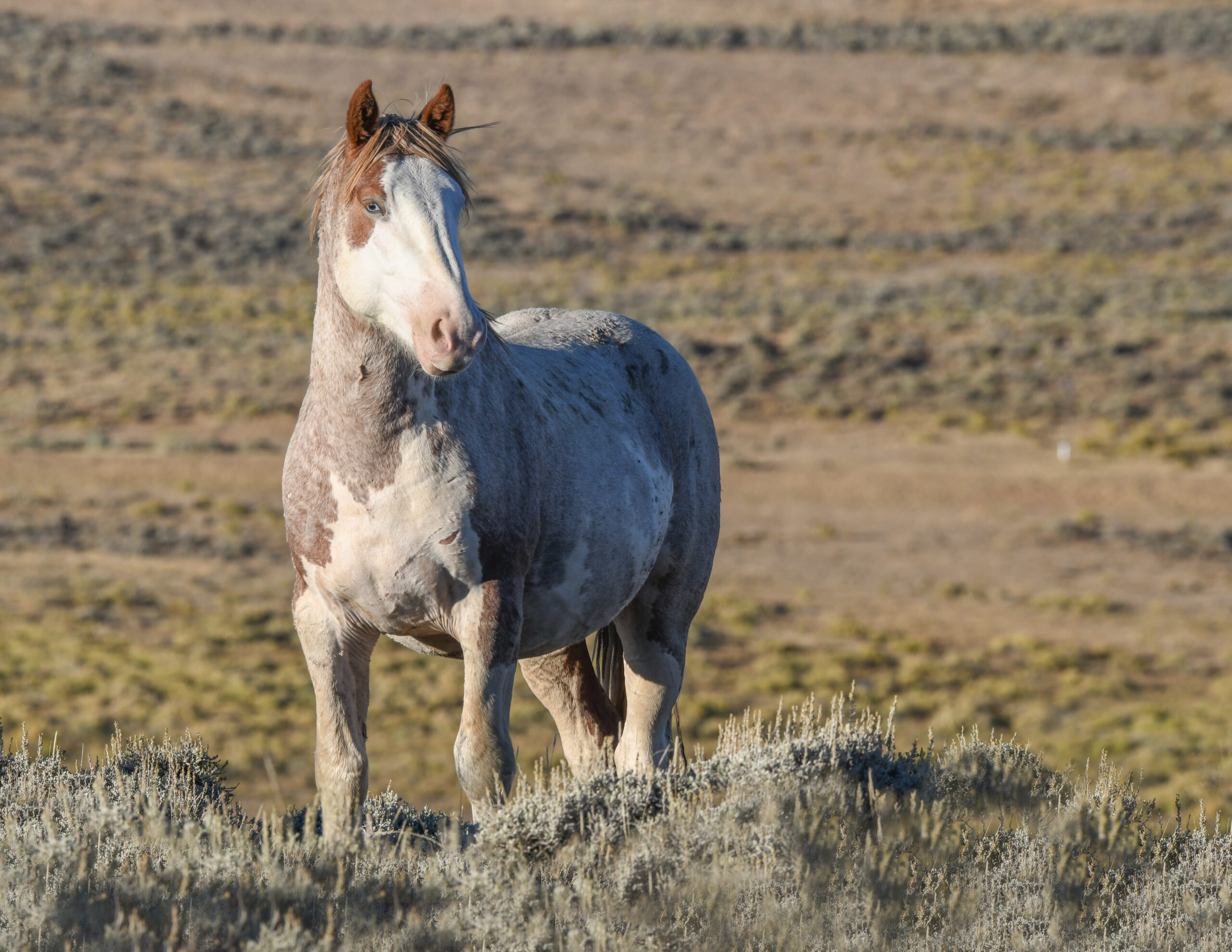
Photo by Meg Frederick
Among the more than 20,000 horses shipped out of the United States for slaughter every year are wild horses that once roamed our public lands.
How that tragedy continues:
Federal law requires that the Bureau of Land Management and U.S. Forest Service maintain population targets for wild herds. The agencies have tried and failed to do so by removing wild horses and burros from the range, usually in helicopter roundups.
Most captured animals end up with tens of thousands of others living in off-range government holding facilities, including often overcrowded corrals.
A few thousand are adopted annually. Others are sold because the law directs the agencies to sell outright wild horses and burros ages 10 and older or any younger horse passed over for adoption three times.
Once title is handed to a wild horse’s new owner, the animal loses its protected status.
All American equines live under threat of slaughter. Slaughter is banned inside U.S. borders on a year to year basis, but a few people profit from buying horses at auction, then shipping them to foreign slaughterhouses.
The agencies aren’t allowed to sell to known kill buyers. But even if the agencies abide by those rules, the threat of slaughter looms.
Wild horses are especially vulnerable. Too often, they end up at auction or suffer abuse or neglect as even well-meaning owners can be overwhelmed by the challenge of training a wild horse or cost of keeping one.
We can’t say how many wild horses are shipped to slaughter because the government stops tracking what happens to them after ownership changes hands.
It doesn’t have to be this way:
- Legislation called the Save America’s Forgotten Equines (SAFE) Act would shut down the foreign slaughter pipeline and ban slaughter here at home for all equines.
- Proven, safe and humane fertility control could replace roundups as the government’s primary management tool, keeping wild horses and burros on the range, but Congress must push the agencies to use it.
Send messages to Congress in support of both the SAFE Act and fertility control